
Blog
The grid bottleneck
One of AI’s biggest infrastructure bottlenecks is the electricity grid.
Artificial intelligence may live in the cloud, but the infrastructure supporting it is increasingly physical.
The infrastructure behind AI
Global electricity demand from data centres grew by 17% in 2025, while electricity consumption from AI-focused data centres surged by 50%, according to the International Energy Agency (IEA). Looking ahead, the IEA expects total data-centre electricity consumption to roughly double by 2030, while demand from AI-focused facilities is expected to more than triple over the same period.[1]
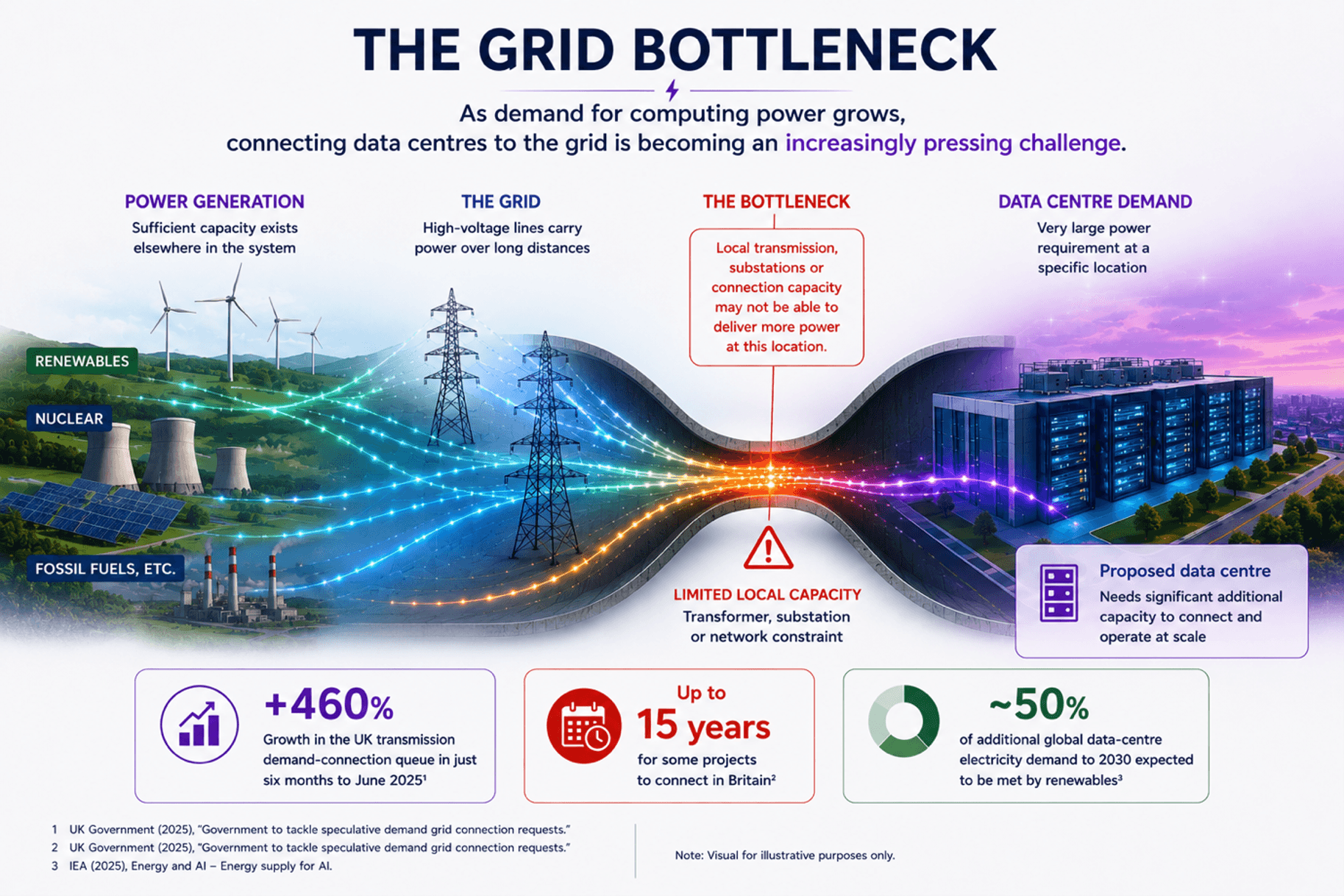
A data centre needs access to sufficient electrical capacity before it can operate at its intended scale. That electricity comes from the wider power system. One of the immediate challenges is not simply building data centres or providing sufficient power generation, but connecting them to the electricity system.
The problem arises when a data centre needs a very large amount of additional capacity at a particular location. Even if sufficient generation exists somewhere in the wider system, the local transmission infrastructure, substations, transformers or connection capacity may not be able to deliver it.
Grid access is becoming the bottleneck
Importantly, the development process isn’t a linear sequence of building a data centre and then applying to connect it.
The UK offers a striking example. In just six months to June 2025, the queue for new demand connections to Britain’s transmission network grew by 460%, contributing to waits of up to 15 years for projects to connect. Part of the problem is speculative applications: developers can enter the connection queue for projects that are not sufficiently advanced, viable or committed to proceed, occupying capacity and delaying projects that are ready to move forward. The government is now tightening requirements and prioritising strategically important developments, including AI data centres.[2]
The reforms go further. The government wants data-centre development to become more strategically aligned with the electricity system, for example, prioritising facilities located near parts of the grid where capacity is already available.
In other words, access to power is increasingly shaping whether and where digital infrastructure gets built.
AI’s infrastructure needs extend beyond technology
For investors, this broadens the investment case for AI.
Much of the attention has focused on semiconductors and the technology companies developing AI. But scaling AI also requires investment across the physical infrastructure supporting it: electricity generation, transmission networks, transformers and electrical equipment, storage and cooling.[3]
That creates opportunities beyond the technology sector. This investment case isn’t new to Path. Some of the portfolios we recommend to clients already include companies providing many of these enabling technologies: from grid construction and renewable-energy engineering to power management, cooling and industrial efficiency. These companies’ products and services are increasingly exposed to data-centre investments.
What AI changes is the scale of demand for some of these solutions.
What AI’s power demand means for renewables
Renewables are expected to be the fastest-growing source of electricity for data centres globally. The IEA estimates that they will meet nearly half of the additional electricity demand from data centres between 2024 and 2030, while natural gas and coal are expected to meet more than 40%.[4]
Renewables have an important advantage in meeting rapidly growing demand: solar and wind projects can generally be built relatively quickly and are now among the cheapest sources of new electricity generation.[5]
Europe is expected to have a considerably cleaner data-centre electricity mix. Renewables and nuclear are projected to supply most of the region’s additional data-centre electricity needs, taking their combined share of total European data-centre electricity consumption to 85% by 2030.[6]
This doesn’t mean AI growth will be powered entirely by clean energy. But it does illustrate how the AI investment story is expanding beyond AI itself.
As demand for computing power grows, connecting data centres to the grid is becoming an increasingly pressing challenge.
[1] https://www.iea.org/reports/key-questions-on-energy-and-ai/executive-summary
[2] https://www.gov.uk/government/news/government-to-tackle-speculative-demand-grid-connection-requests
[3] https://www.iea.org/reports/key-questions-on-energy-and-ai/executive-summary
[4] https://www.iea.org/reports/energy-and-ai/energy-supply-for-ai
[5] https://www.irena.org/Publications/2026/Jul/Renewable-Power-Generation-Costs-in-2025
[6] https://www.iea.org/reports/energy-and-ai/energy-supply-for-ai
Important information: This article is for general information only and does not constitute personal investment advice. The value of investments can fall as well as rise and you may get back less than you invest. References to investment themes or portfolio holdings are illustrative and should not be regarded as a recommendation to buy or sell any particular investment.
MORE NEWS AND EVENTS




























RISK WARNING
As always with investments, your capital is at risk. The value of your investment can go down as well as up, and you may get back less than you invest. This information should not be regarded as financial advice.