
Blog
From Concentration to Diversification: Is US exceptionalism fading, or are markets diversifying again?
Winners don’t stay winners
While much of the media attention remains focused on Tech and AI, a quieter shift is taking place in the background. Whether driven by stretched valuations or rising political and fiscal uncertainty in the US, investors are beginning to reassess their exposure to US and Tech equities.
History reminds us that no single country or sector sustains outperformance indefinitely.
Performance of MSCI country indices over 5 recent decades
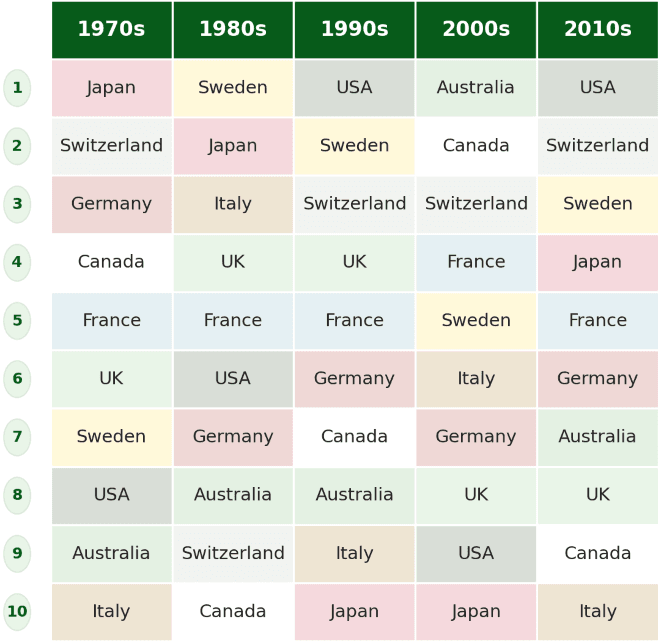
Source: IBES, LSEG Datastream, S&P Global, JPM – 11/10/2024
S&P 500 sector performance over the last 14 years
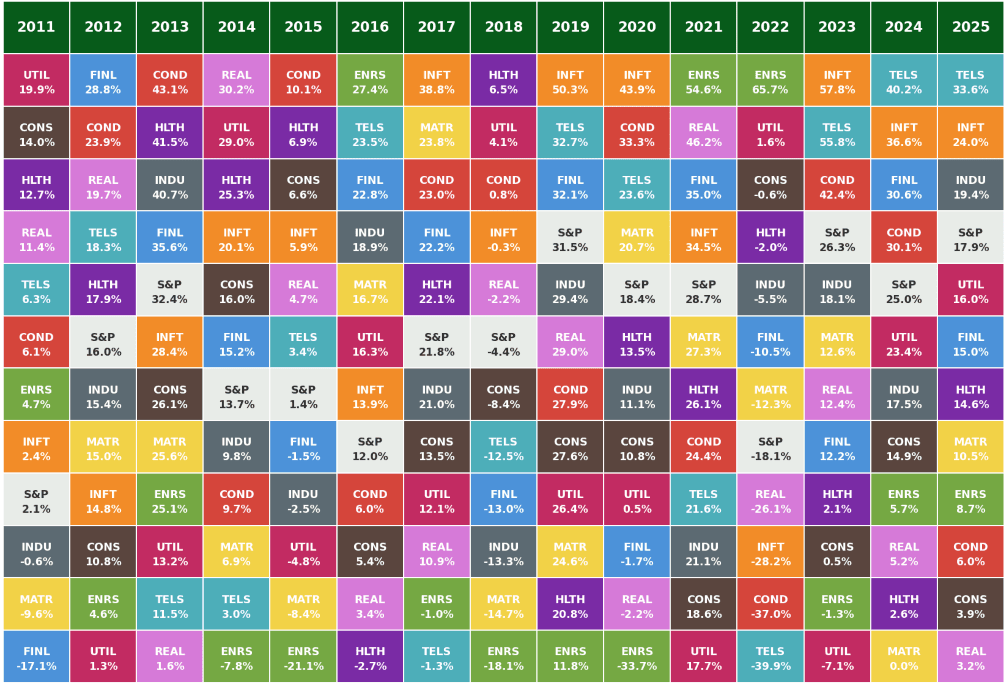
Source: S&P Global
Key: UTIL = Utilities | FINL = Financials | COND = Consumer Discretionary | CONS = Consumer Staples | HLTH = Health Care | INDU = Industrials | INFT = Information Technology | MATR = Materials | REAL = Real Estate | TELS = Communication Services | ENRS = Energy>
These charts illustrate how leadership has rotated over time, both across countries (left) and sectors (right).
So, is this the beginning of the end for US exceptionalism?
Following a brief dip after the introduction of US tariffs (Trump’s ‘Liberation Day’) in April 2025, markets recovered. However, attention quickly shifted to signs of excess in AI-related valuations, particularly in private markets – this is the likes of OpenAI, xAI, and Anthropic. While these companies sit outside our portfolios, they contribute to broader concerns around spillovers of a potential bubble burst into the broader economy.
A change in leadership
US policy uncertainty has undermined investor confidence in US assets, leading to a repositioning. Fund flow data shows a clear moderation in demand for US equities relative to recent years[1], with more capital allocated towards Emerging Markets in part due to a weaker US dollar, and to Europe, benefiting from defence spendings. At one point, US equities attracted just $26 of every $100 of global equity inflows – a sharp decline from $92 at the peak in 2022[2].
Flows however partially recovered in early 2026 amidst hope for easing geopolitical tensions, highlighting how sensitive markets remain to political and fiscal developments[3].
At the same time, market leadership is broadening. The so-called Magnificent 7 (Apple, Amazon, Alphabet, Meta, Microsoft, NVIDIA and Tesla), which have driven a large share of returns in recent years, have lagged the broader market in 2026[4]. This suggests a shift away from a narrow group of winners toward a more diversified set of drivers.
Why diversification is key
Despite elevated geopolitical risks, equity markets remain near all-time highs. This disconnect has raised concerns among policymakers that risks may not be fully reflected in asset prices[5]. While markets may simply be looking through short-term uncertainty and focusing on future growth, it reinforces a core principle of investing: diversification. This is because winners don’t stay winners and certain asset types or sectors perform better than others in volatile markets.
In periods of uncertainty, investors often turn to assets and sectors with more stable, long-term demand. This includes areas such as infrastructure, water, waste, renewables and electrification.
We refer to these as ‘HALO’ businesses – the heavy, asset-backed companies with low obsolescence risk, supported by long-term structural demand such as the projected increase in energy consumption. These businesses tend to offer more resilient cash flows and lower disruption risk than those relying heavily on high-growth expectations.
Our portfolios maintain exposure to these areas as part of a diversified approach focused on long-term structural themes.
Our approach
Amidst market volatility, our approach remains the same: stay invested, diversified, and avoid over-reliance on any single region or sector. No one can predict the future consistently, which is why we continue to follow the core principles of investing that have stood the test of time.
Important information: This article is for information purposes only and does not constitute personal financial advice or a recommendation to invest. The suitability of any financial planning strategy depends on individual circumstances. Tax treatment depends on individual circumstances and may change in future. The value of investments can fall as well as rise and you may get back less than you invest.
MORE NEWS AND EVENTS



































RISK WARNING
As always with investments, your capital is at risk. The value of your investment can go down as well as up, and you may get back less than you invest. This information should not be regarded as financial advice.