
Insights
Stewardship: balancing ethics and impact in sustainable investing
Sustainable investors often face the challenge of reconciling their ethical values with the pursuit of meaningful impact. Divestment from industries like fossil fuels or controversial weapons and positive screening to select high-performing ESG companies are common strategies in sustainable investing. But are they the most effective tools for driving real-world impact?
Ethics vs. impact: understanding the difference
• Ethical investment strategies focus on aligning portfolios with moral principles. Divestment and exclusion ensure investors do not profit from industries they oppose, while positive screening favours companies with high sustainability standards.
• Impact focuses on measurable improvements, such as reducing carbon emissions or improving labour practices. Ethical alignment, while important, does not inherently drive impact, such as lowering carbon emissions or strengthening social practices.
Shortcomings of divestment, exclusion and positive screening
Divestment and exclusion
- Ethical clarity, limited influence: While divestment and exclusion can bring ethical clarity and raise awareness of certain concerns, some studies argue that it comes down to transferring ownership of a problem from an investor to a typically less sustainability-conscious one.
- Uncertain systemic impact: Price changes on secondary markets primarily affect buyers and sellers, with limited evidence that divestment materially increases a company’s cost of capital to drive behavioural change. When cost increases do occur, it is unclear what market factors trigger them.
Positive screening
- Rewarding the already green: Positive screening focuses on companies with strong ESG credentials, often overlooking “brown” firms that have the greatest potential to improve.
- Limited systemic progress: By prioritising green companies, positive screening risks neglecting opportunities to drive meaningful change in high-impact sectors.
Stewardship: Impact and Transition Through Engagement
The potential for positive impact is often greatest where harm is most significant. Stewardship focuses on active engagement rather than exclusion, allowing investors to use their shareholder rights to influence corporate behaviour. This strategy is particularly impactful in driving transitions in “brown” sectors where progress is most needed, making it a powerful alternative to divestment or positive screening.

A standout example from our portfolios is Ørsted, which transitioned from a fossil fuel-dependent utility to the world’s largest offshore wind operator. The company has installed 9.9 GW of offshore wind capacity globally[1], including 12 UK wind farms with a total capacity of 5.6 GW—enough to power over 6 million homes and generate more than 7% of the UK’s electricity annually[2].
Advantages of Stewardship
- Driving change from within: Stewardship enables investors to guide companies toward sustainability goals while holding them accountable.
- Transition-focused impact: Unlike exclusion, stewardship works with firms to drive measurable improvements, fostering transitions in sectors with the greatest challenges and opportunities.
Challenges and limitations
While stewardship is often promoted as a cornerstone of responsible investing, it is not without challenges and limitations:
- Conflicts between ethics and fiduciary duty: Asset managers often prioritise shareholder returns over societal impact, focusing on material issues tied to financial performance rather than broader environmental or social improvements.
- Resource-intensive nature: Proxy voting, shareholder resolutions, and direct dialogue require significant resources, making them more accessible to large asset managers than smaller investors.
- Power dynamics and collective action: Successful stewardship relies on the influence of major investors. Smaller players face challenges in achieving the same level of impact, and collective action, though more effective, often involves navigating diverse stakeholder agendas.
- Long-term horizon for impact: Change through stewardship takes time, requiring patience from investors seeking immediate results.
Hence the importance to select investment managers with best-in-class stewardship credentials and significant voting power.
Improvement Over Exclusion
Ethical strategies like divestment, exclusion and positive screening align portfolios with values but often fall short in driving substantial progress. Stewardship, while not without challenges, offers a pathway to bridge the gap. By prioritising active engagement and fostering improvement over exclusion, investors can maximise both ethics and impact. When making investment choices, investors must carefully consider where their influence can drive the most meaningful change.
Banks play a critical role in the climate transition by deciding which activities receive financing. At Path, we select investment partners who share our ethos, ensuring our clients’ capital drives meaningful impact.
Our DFM partner EQ has taken an active stance by joining ShareAction’s investor coalition on UK and European banks. This year, they engaged with HSBC’s Head of Sustainability to push for greater transparency on emissions linked to underwriting and challenged Standard Chartered at its AGM on setting clear targets for green financing.
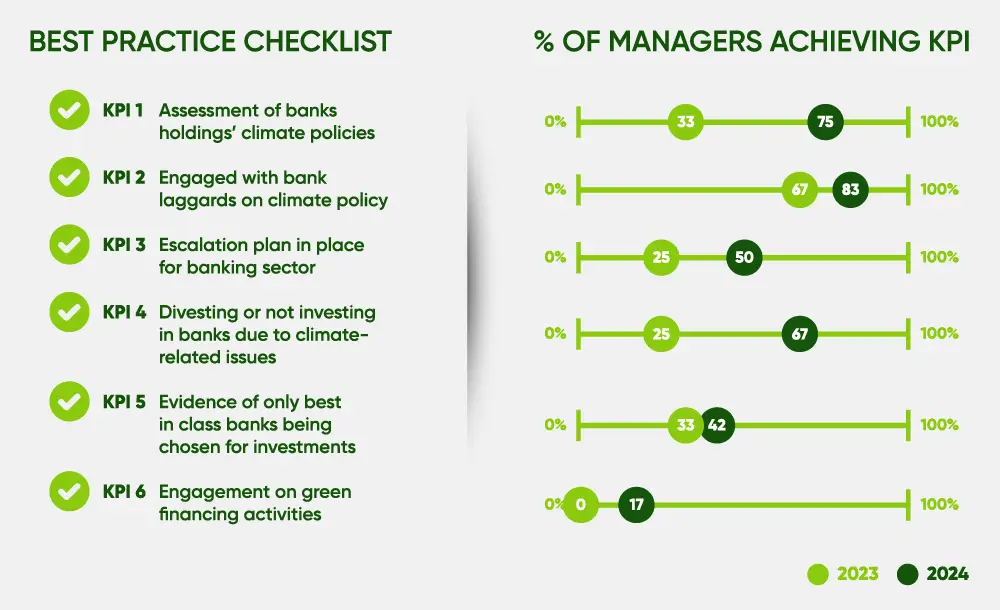
EQ also assessed 12 asset managers on their approach to banks’ climate policies. The KPI graph below highlights how consistent engagement helps raise awareness among asset managers about the pivotal role banks play in financing the climate transition.
-

- Source: EQ Positive Impact Report 2024
Our vision
Our research-driven approach recognises the value of divestment, exclusion, and positive screening for aligning portfolios with investors’ values. However, we also understand their limitations in driving systemic change, and recommend a stewardship approach to investors seeking to make more meaningful impact.
We believe that true sustainability comes from a balanced approach, combining ethical integrity with meaningful impact, which reflects in our portfolios range. By integrating stewardship into our offerings, we aim to help clients not only align their investments with their values but also make a tangible difference in the world.
Important information: This article is for information purposes only and does not constitute personal financial advice or a recommendation to invest. The suitability of any financial planning strategy depends on individual circumstances. Tax treatment depends on individual circumstances and may change in future. The value of investments can fall as well as rise and you may get back less than you invest.
RISK WARNING
As always with investments, your capital is at risk. The value of your investment can go down as well as up, and you may get back less than you invest. This information should not be regarded as financial advice.