
Insights
Risk & Reward
Meta view
“Change is the only constant”. So reads the phrase synonymous with human ingenuity and desire for progress. Knowing change will come is one thing, but understanding how to adapt to it – and further still – how it might impact your financial independence and standard of living is quite another.
The capitalist free market is an efficient mechanism for achieving profit, regardless of cost. But progress in the current market framework is inhibited by outdated perceptions and archaic ideas of what is needed to make a financial return, whilst profit-maximisation has led to corner cutting and negative externalities many times in the past. This ‘boom and bust’ story has been central to economic prosperity for most of the post-war era, resulting in a huge advance in living standards. The issue we face now – arguably the defining issue of our species – is that this has compromised the nature around us, the air we breathe and the food and water we consume.
For humans to thrive on this planet – remember, it will exist after we are gone, so survival is not merely the aim – the view that profit and positive externalities are mutually exclusive must be challenged, and an alternative pursued.
If the scale of the change required seems unsurmountable, we must still understand why it is necessary and inevitable. Let’s look at just one area – fossil fuels. A company extracting fossil fuels will one day have nothing to extract. This is not a subjective view, because hydrocarbon resources are finite, and we extract too much of it. But before that moment comes companies, governments, and the general population will realise that hydrocarbons can no longer reliably provide for them. Shareholders in a fossil fuel extracting company will find they do not have a willing buyer, any physical assets already extracted will be deemed stranded. Given there will be no financial benefit from the asset after that date, it will turn into a terrible investment (recent research has highlighted how Big Tech pension funds could have improved their employee’s pension pots by up to $5.1 billion, if they had moved the pension fund assets out of fossil fuels 10 years ago[1]).
This inevitable outcome is the free-market in action. We argue that we still need the free-market – just one with sustainability and the vision of a prosperous world at its core – and are excited that that the problems we face are merely the start of a new beginning. Al Gore, former US vice president and Nobel Price-winning environmentalist, called climate change “the biggest investment opportunity in history” (among other things). It is hard to disagree, especially in the energy sector where the technology to replace fossil fuels already exists. What it needs is further momentum and investment, to embed the infrastructure and efficiencies.
The benefit to you, as an investor, is primarily that you are still early enough to the party. Granted, climate change and a more ‘conscious capitalism’ are not new topics, but most people have not yet considered how this shift will impact their financial lives; their pensions and investments, and thereby their standard of living, let alone taken action to accommodate this shift. By making a change now, you will be ahead of the early majority, and perfectly positioned to catch increased capital flows. We have a recent real-life example of this. In March 2020, investment markets dropped precipitously because of Covid lockdown mandates and the economic and humanitarian consequences of the virus becoming very real. With a laser-sharp consideration of the world around us, money flooded to investments which promised more sustainable products and services. To not be invested in such companies meant sub-par returns. Since then, an important consolidation has taken place (including a clamp down on ‘greenwashing’) but when the chips were down, it was the concept and hope of sustainability to which investors turned. When we look back, this should prove to have been an important ripple before the coming wave.
With the “tech revolution” over 20 years old, and AI poised to change our lives further still in the coming years, what chances the likelihood of an ‘impact revolution’? Without the desire and ability to change, economies will stagnate. Far from being a distant concept, the opportunity is more immediate. The last year has seen a seminal collaboration between The Natural History Museum, and Bloomberg (the world leader in investment market data and analytics), in releasing a Biodiversity Intactness Index, linked to 50,000 global companies. This insight into Biodiversity impact of business activities is a world first for the investment industry, so the wheels are turning even for the most ardent supporters of old economy practices. Let’s get ahead of it.
The argument extends beyond environmental concerns. Externalities are generated by business activities across all sectors and products – any companies that do not keep up with the changing world inevitably fall away. This is why companies have always innovated – American Express was founded based on express mail delivery, and Amazon started life with the physical delivery of books. As such, whilst the biggest companies today may remain so, what chances would you give the next big opportunity joining them being a company that prioritises not just profit, but beneficial social outcomes in a globalised, connected world. In the finance sector, instead of exposure to behemoth financial institutions (themselves heavily embedded in lending to ‘old-economy’ companies) what about the opportunity in supporting smaller financial institutions providing micro-finance to entrepreneurs in emerging economies; this not only helps lift the floor of living standards to that region, but provides the opportunity for less economically developed regions to compete on a bigger scale, creating a further investment opportunity at an attractive price for an investor.
Central to this coming change, is the challenge it presents to the incumbent risk/reward relationship.
Risk and return
There are several key areas to consider when understanding how ‘risk’ interacts with your financial affairs. Examples include your time horizon, income and capital needs, your ‘natural’ attitude to risk, and your objectives. Go to any other adviser, and they will gladly talk to you about this.
Beyond this, systemic factors also pose a risk, such as inflation (which erodes purchasing power over time), liquidity (can you sell if you had to?), and diversification (are all your eggs in one basket?).
Tools exist to help contextualise these systemic risks, so that an fund may be given an easy-to-digest risk rating. On a scale of 1 to 10, a risk rating of ‘1’, for example, may represent an ultra-cautious approach to investing, where the investors would rather have cash under the mattress than invested in the stock market. On the other end of the spectrum – say, a ‘10’ – would be very adventurous; Such an investor welcomes the volatility of their investment, keeping faith that this is a natural part of the journey to generating healthy returns over time.
In the context of impact and sustainable investing, an intriguing relationship therefore presents itself.
The conventional wisdom amongst fund rating firms, is that the risk profile (of 1-10) given to a fund can be derived from historic data. i.e. Expected future risk, derived from looking in the rear-view mirror.
Almost unbelievably the investment management industry and its regulator too only really take three factors into account when risk profiling:
- Past performance of different asset classes;
- Past volatility of different asset classes;
- Asset allocation based on historic outcomes.
Whilst the tagline for the investment industry is that “Past performance is no guide to future returns”.
| RISK PROFILE | 1 | 2 | 3 | 4 | 5 | 6 | 7 | 8 | 9 | 10 |
|---|---|---|---|---|---|---|---|---|---|---|
| CASH | 100% | 35% | 20% | 9% | 9% | 9% | 9% | 5% | 3% | 0% |
| UK INDEX-LINKED GILTS | 0% | 0% | 0% | 0% | 0% | 0% | 0% | 0% | 0% | 0% |
| UK FIXED-INTEREST GILTS | 0% | 0% | 0% | 0% | 0% | 0% | 0% | 0% | 0% | 0% |
| UK CORPORATE BONDS | 0% | 23% | 25% | 22% | 17% | 11% | 4% | 3% | 0% | 0% |
| GLOBAL (EX-UK) FIXED INCOME | 0% | 14% | 14% | 14% | 9% | 6% | 3% | 0% | 0% | 0% |
| PROPERTY | 0% | 5% | 5% | 5% | 5% | 5% | 5% | 4% | 0% | 0% |
| UK EQUITY | 0% | 12% | 13% | 15% | 15% | 13% | 12% | 11% | 9% | 8% |
| EUROPE (EX0UK) EQUITY | 0% | 0% | 3% | 5% | 6% | 7% | 8% | 8% | 8% | 7% |
| US EQUITY | 0% | 5% | 8% | 13% | 18% | 22% | 25% | 26% | 29% | 23% |
| JAPAN EQUITY | 0% | 0% | 3% | 3% | 5% | 5% | 6% | 7% | 7% | 6% |
| DEVELOPED PACIFIC (EX-JAP) EQUITY | 0% | 3% | 3% | 8% | 9% | 11% | 13% | 14% | 14% | 11% |
| EMERGING MARKET EQUITY | 0% | 3% | 6% | 6% | 7% | 11% | 15% | 22% | 30% | 45% |
Path Financial challenges conventional thinking. A very strong future focus channels client money into investments that will improve outcomes for people and planet. An inevitable and beneficial spin-off from a future focus it that it also improves financial outcomes with a much more sophisticated investment management and risk analysis.
In our view this is the investment management equivalent of driving somewhere by only looking in the rear-view mirror.
Imagine you are a younger investor, with a 30-year investment time horizon, but also that you are naturally cautious. That is, closer to the ‘1’ end of the investment spectrum, than a ‘10’. The argument favouring taking a cautious approach is to minimise the fluctuation in value of your investments, allowing you to sleep more comfortably at night. Over time though, this approach introduces more risk than you thought, and the concept is flipped on its head – no longer are you being cautious with your money, but rather allowing it to be eroded by inflation, and very likely to fail in delivering the returns you need to fund your desired lifestyle in 30 years time. Arguably, you are being reckless and setting up your future self for failure.
The real world and risk megatrends
The current risk/reward framework, on its own falls far short of accounting for the changing world around us. Used in isolation we argue it is no longer fit for purpose. Without considering the bigger picture, the implications for your financial security are very real. “Climate Value at Risk” models exist already, but they must become mainstream to fully capture the very real downside that a traditional investment approach has baked into it.
Risks not typically accounted for in the current framework comprise systemic issues not yet mentioned like: climate risk; legislation; reputational / PR risks; socio-economic, and societal changes.
But these are risk factors, with real economic consequences. The systemic issues on our doorstep only exacerbate the problem you will face down the line, and which conventional risk modelling falls short of accounting for:
1 – Climate litigation: In April 2024, Europe’s top human rights court ruled that the Swiss government has violated its citizens human rights, by failing to sufficiently combat climate change. The ruling sets a precedent for other communities across countries to bring climate litigation to their high courts. By extension, states will be aware of the ever-increasing pressure to help finance climate-positive projects.
In the US, more than 20 local and state governments are challenging oil firms on their broken promises, whilst youth activists and complainants have already had success in Montana – a judge ruling in favour of residence claiming the state’s policies in fossil fuel productions violated their rights.
These legal challenges may have seemed far-fetched half a generation ago, but there is an expectation for climate litigation to continue to take off from here.
And who will be there to insure the perpetrators? Versus just a few years ago, the more attractive investment opportunity in the insurance sector now, would be holding stock in one which is not underwriting firms or households at risk from changes in the climate. Beach side residents on the US coastline have seen their home insurance cancelled, in fear of rising sea levels. 2023 saw the largest ever number of billion-dollar insured losses from extreme weather (37, compared to less than 10 in 2001)[2].
Climate risk affects the bottom line.
2 – Great wealth transfer and demographic changes: Whilst the exact amount of wealth to be passed through the generations is hard to predict (estimates range widely from $15 Trillion over the next 10 years globally (Wealth-X, a global wealth research firm) to $90 Trillion in the US alone (Knight Frank Wealth Briefing), it is certain that a seismic reallocation of capital is underway.
Western Europe and North America has largely been shaped by the “baby boomer” (born 1946-1964) generation, though their power is starting to fade. Gen Z and Millennials account for about 30% of household spending in the USA, whilst the European Union has around 125 million individuals between age 10-34 (Economist). This changing demographic will have to live through severe climate change, and will increasingly drive investment towards providing solutions to the challenge.
It cannot be assumed therefore, that there will always be a willing buyer of your shares if you don’t future proof your portfolio. In the energy sector, arguably, several states in the middle east are aware of this pending issue, hence their rapid and ambitious application of ‘sportswashing’ in recent years, taking advantage of oil & gas profits before they must inevitably switch to being exporters of solar.
It is better to be ahead of the crowd and look at the macro trends.
3 – Carbon reduction and climate change: The Paris Agreement is a legally binding international treaty, aiming to decrease carbon emissions by 2050 to a ‘net zero’ level. Before then, emission reduction targets are 45% by 2030. The Green Deal and the US Inflation Reduction Act, are all in place to aid the transition to a more sustainable energy production model. At some point on this timeline, companies not on this journey – because they did not start soon enough, or because their incumbent operations are too difficult to change – will quickly become unattractive investment opportunities. The cost of reducing carbon emissions grows the longer it is left unaddressed. For fossil fuel extraction companies, the problem already exists, given the assets already extracted will become stranded, if they do not have a willing buyer. For now their profits rely on political instability and conflict.
In 2024 the International Energy Agency reported that electricity production had passed a critical tipping point. Renewables are now replacing fossil-fuel as a means or generating electricity at a now un-stoppable rate. Extrapolating that thought, it could be that in the second half of the century there is an over-supply of renewable energy. This in turn allows excess electricity to be utilised to create other forms of ‘clean’ fuel – e.g. green hydrogen.
There are reasons why it is currently expedient to dig up fossil fuels, transport them inefficiently around the world and then burn them. But then there was a time when steam trains has to carry their own coal and water around with them. But trains evolved through diesel and to electricity and maglev. It seems that cars are on a journey to cleaner fuels now as is shipping and other forms of freight. All of this has huge impacts on risk and the financial performance of certain asset classes. There will be winners and there will be losers.
The climate transition is a real problem for high emission-producing companies and those without a plan.
4 – Reputation and PR damages: There are plentiful examples of poor governance destroying a company’s reputation and even its solvency (Enron anyone). Volkswagen’s 2015 Emissions Scandal is a perfect example of malpractice and governance delivering sub-par returns. Discovery of the scandal saw the share price drop, from a level not since reached again. In 2016 they established their Sustainability Council, with ambitious ESG goals across all business areas.
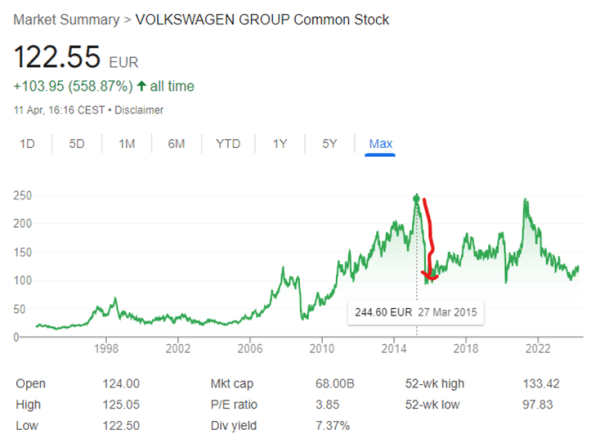
Source: Google Finance
Poor governance and malpractice undermines profitability, and reduces returns to shareholders.
5 – Funding requirements and tipping points: A net-zero global economy requires around $3.5 trillion per year of capital investment[3]. Part of this can be met by declining investment into fossil fuels, but most will need to come from new capital flows, investment into emerging technologies, an increase in renewables efficiency, and improved company reporting to underpin and commit to these deadlines to avoid reputational, and legal risks.
As products and solutions mature along the ‘S curve’ of adoption, the transition will gather momentum. Markets will begin to price in these tipping points, which will cascade as more sectors are beneficially impacted. Historically, betting against domestic appliance purchases (fridges, microwaves, TVs), or digital adoption (personal computers, the smart phone) was a bad choice. AI is next, along with energy production and the network of infrastructure on which modern supply chains are built.
Betting against this will be quite the gamble.
You have the opportunity to align your investments with these funding requirements, before the majority.
Our portfolios – forward thinking investment management
Our conviction is that “impact investment” is not only the best, indeed only way to encourage and expedite the positive power of capital – but it will lead to the best returns. We do not believe the real investment opportunity lies solely in “avoidance”. We also focus on those companies that are providing solutions to today’s pressing environmental and societal issues. Companies that have failed to keep up with evolving needs and trends include many previously household names – where are they now?
- Kodak
- Blackberry
- Blockbuster
- Borders Books
- Tie Rack
- Smith Corona typewriters
- Tower Records
- Toys R Us
- MySpace
- Friends Reunited
A “positive inclusion” approach not only speaks to people’s values (which for some may be sufficient), but is crucial to mitigate the investment risk we have just addressed.
What we analyse and understand in terms of positive impact and ESG metrics also informs our risk assessment. This results in a much more sophisticated process than most asset managers employ.
We also take these factors into account:
- Geography and geopolitical risk;
- Soil quality and degradation, biodiversity;
- Insurance risk;
- Demographic trends (e.g. ageing populations);
- Infrastructure trends;
- Sociological and moral evolution;
- Technology trends & innovation;
- Net-zero commitments;
- Gender rebalancing;
- Urbanisation, deglobalisation and nationalism.
From a client perspective:
- Duration of an investment;
- The risk of being risk-averse;
- Taxation trends.
The longer the time horizon, the less an investor can afford to buy into companies and projects aligned with the ‘old economy’. If you knew that the combustion engine was going to be replaced by batteries, or that energy generated from (limited) oil reserves in the ground would be replaced by natural elements such as sun, wind and water, would you place your life savings and retirement plan into the former? Would the conventional approach to ‘risk’ suddenly look more fragile? We can see this happening in front of our eyes – Solar and Wind Power growth recently has mean that renewable generated a record share of global electricity production in 2023, above 30% of total electricity generation.
The companies of today may well successfully pivot, to retain their relevance into tomorrow. However, the next big opportunity, with the greatest upside, is likely to come from a company that is smaller or more medium sized currently. Prysmian may be one such example. They have entered our universe within the last year, and specialise in the production and installation of wires and cable systems including undersea cables powering offshore wind farms, underground cables, signalling cables and battery cables. At the beginning of 2024, the business was reorganised improving the green credentials and for the long-term growth drivers of the company, which are linked to the energy transition, digitalisation and electrification. The return on the company has been strong, and who is to say this medium sized firm does not become tomorrow’s renewable infrastructure behemoth.
The opportunity ahead of us is compelling, and our ethos and holdings are already aligned with the world of tomorrow. It is up to others to play catch up.
Important information: This article is for general information only and does not constitute personal financial, investment, tax or legal advice. Tax treatment and suitability depend on individual circumstances and may change. Investments can fall as well as rise in value, and you may get back less than you invest.
RISK WARNING
As always with investments, your capital is at risk. The value of your investment can go down as well as up, and you may get back less than you invest. This information should not be regarded as financial advice.